Twigs
adapted from Woody Plants of the Blue Ridge by Ron Lance. Used by permission.
To see photographic examples of a term, click the camera next to it in the list of botanical terms.
The current or most recent woody growth, forming the ends of a stem, is the twig.
The previous season's growth (last year's twig) is the branchlet, sometimes called a 2nd-year stem.
The branch is 3 years or more in age.
A culm is the vertical woody stem of bamboos, which have no twigs. The word cane is also used, but cane is also applied to the stems of the genus Rubus, which have true twigs and branchlets.
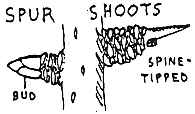
A spur shoot is knobby, short, and very slow-growing. It usually produces flowers or clustered leaves and lies along the side of a branchlet or branch. Sometimes it may be spine-tipped, or merely have a bud at the tip.
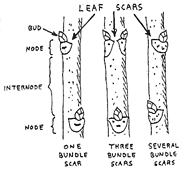
A node is the portion of a twig where vascular tissue exits and enters; this is where leaves arise.
Internodes are intervals of twig between nodes.
Where a leaf falls from the twig, a leaf scar is left behind. Inside the leaf scar the vascular tissue pattern is seen, usually as dots or bundles of dots. These are bundle scars, aiding species identification during Winter.
Buds are also found at nodes, usually in axil of leaf petiole and twig or hidden under petiole base, or sunken in twig.
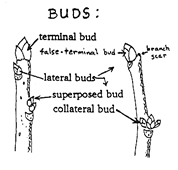
Position of buds: Where the twig ends growth by forming a bud on the very tip, a terminal bud is present. When the growing tip withers or falls away, one of the side buds (or lateral buds) ends up being close to the twig tip and substitutes as a terminal bud for next year's growth. These are pseudo-terminal or false-terminal buds; look for the telltale branch scar or branch stub alongside it, opposite from leaf scar. This is where the twig tip has fallen.
Lateral buds can be superposed (one above the other) or collateral (side by side) on the same node. Often, one of these accessory buds is for flower production and may look different than other lateral vegetative buds.
Buds can be sunken or submerged in the twig (not visible), naked or scaled.
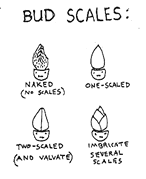
A naked bud has the first set of leaves folded and visible as the outside of the bud, or a heavy layering of hair obscures any distinction of scales.
Scaled buds have one or more bud scales (which are modified leaves) to protect embryonic leaves Inside. When 2-scaled, the scales may be valvate, or meet like two cupped hands. Imbricate scales overlap at edges.
Other twig features:
Superficially, twigs may be lined (raised ridges extending down from leaf scars) or angled (not rounded in cross-section). Zig-zag twigs are bent in alternating angles from one node to the next.
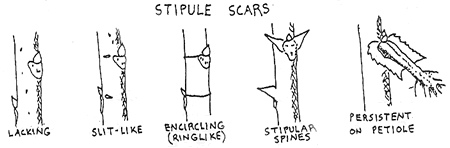
Stipules are leaf-like appendages found in some plants, usually at base of petiole or twig nodes. They leave various-shaped scars, or harden into spines.
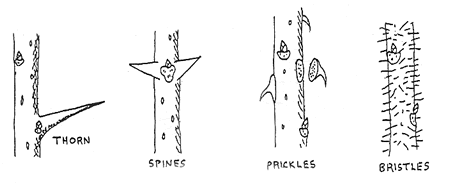
Armed twigs have sharp thorns, spines, or prickles —
- Thorns are outgrowths of the wood of the twig.
- Spines are usually associated with nodes and are modified stipules or twig tips.
- Prickles are epidermal outgrowths, such as in roses and blackberries.
Bristles are trichomes ("hairs") from the epidermis; stiff but not hardened and sharp.
Lenticels are dotlike pores for gas exchange. They can be tiny or conspicuous, raised and corky, or elongated horizontally.
Aerial rootlets are thickened fibers for climbing, found on some vines.
Tendrils are twining petiole, stipule, or twig modifications that aid climbing in some vines.
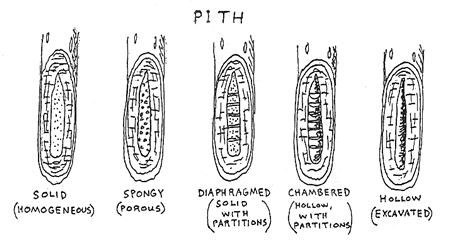
Pith is the soft central core or interior of twigs. Its shape is seen in cross-section, its texture by splitting or halving the twig lengthwise using a sharp knife.