
The Southeast Mountains
adapted from Woody Plants of the Blue Ridge by Ron Lance. Used by permission.
The Southern Appalachian Region
can be identified as containing
three separate physiographic provinces:
- the Blue Ridge,
- Ridge and Valley, and
- the Cumberland Plateau.
Elevations, for the most part,
lie between 1000 to over 6000 feet
above sea level in the region.
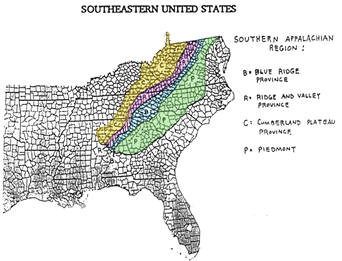
The Cumberland Plateau in TN and AL contains mostly mesophytic hardwood forests over limestone or sandstone rock substrates. Elm. Hackberry, Ash, Sugar Maple, Hickory, Chinkapin Oak, and Scarlet Oak are common canopy species. Some endemic or uncommon species typifying this and the next province include Neviusia alabamensis, Conradina verticillata, Cotinus obovatus, Fraxinus quadrangulata, Ulmus serotina.
The Ridge and Valley Province lies just eastward of the Cumberland Plateau. It is characterized by long, narrow ridges oriented northeast by southwest, with deep, narrow valleys between. Vegetation and rock substrates are sufficiently similar to that of the Cumberland Plateau that references made to a plant's habitat on the Plateau can often be assumed to apply to the Ridge and Valley Province as well.
The Blue Ridge forms the easternmost ranges and escarpment of the Southern Appalachians, characterized by more irregular topography than the western provinces, and metamorphic rock substrates of acidic to neutral pH ranges. The predominantly acidic soils favor more forests rich in oak or oak- conifer communities, with ericaceous understories. Since the disappearance of the province's most characteristic canopy species, the American Chestnut, some of the important community types of present-day forests are described on under Plant Communities.
The Piedmont province begins at the "foothills" area of the eastern escarpment of the Blue Ridge. The Piedmont is sometimes included as part of the Appalachian Region (as it was once the "base" of these mountains).