
Spermatophytes (seed plants): Angiosperms (flowering plants): Eudicots: Core Eudicots: Asterids: Campanulids: Asterales
WEAKLEY'S FLORA OF THE SOUTHEASTERN US (4/24/22):
Lobelia inflata
FAMILY
Campanulaceae
Go to FSUS key
Dig deeper at SERNEC, a consortium of southeastern herbaria.
Read more about Indian-tobacco at Vascular Plants of North Carolina.
SYNONYMOUS WITH
PLANTS NATIONAL DATABASE:
Lobelia inflata
FAMILY
Campanulaceae
SYNONYMOUS WITH VASCULAR FLORA OF THE CAROLINAS (Radford, Ahles, & Bell, 1968) 178-06-008:
Lobelia inflata FAMILY Campanulaceae
SYNONYMOUS WITH Manual of the Southeastern Flora (Small, 1933, 1938)
Lobelia inflata
COMMON NAME:
Indian-tobacco, Pukeweed
To see larger pictures, click or hover over the thumbnails.
)
USDA Forest Service / A Guide to Medicinal Plants of Appalachia. 1969 mpa_page_165
)
USDA-NRCS PLANTS Database / Britton, N.L., and A. Brown. 1913 pnd_loin_001_lvd
)
JK Marlow jkm220510_7759
May Greenville County SC
Bald Rock Heritage Preserve
)
JK Marlow jkm220626_8675
June Greenville County SC
Tall Pines Wildlife Management Area
)
JK Marlow jkm220626_8676
June Greenville County SC
Tall Pines Wildlife Management Area
Lower flowers with ovate-leafy bracts, per Weakley's Flora (2022).
)
JK Marlow jkm220626_8677
June Greenville County SC
Tall Pines Wildlife Management Area
Stems long-hirsute, per Weakley's Flora (2022).
)
JK Marlow jkm0407y_07
July Greenville County SC
Stem hairy and often branched, per Wildflowers of the Southern Mountains (Smith, 1998).
)
JK Marlow jkm120704_436b
July Greenville County SC
Ashmore Heritage Preserve
Bracts longer than the pedicels. Calyx lobes linear, 2-7mm long, entire, per Vascular Flora of the Carolinas (Radford, Ahles, & Bell, 1968).
)
JK Marlow jkm190702_9596
July Greenville County SC
Tall Pines Wildlife Management Area
)
JK Marlow jkm190702_9598
July Greenville County SC
Tall Pines Wildlife Management Area
)
JK Marlow jkm190726_0151
July Transylvania County NC
DuPont State Forest
)
JK Marlow jkm190726_0153
July Transylvania County NC
DuPont State Forest
The calyx becomes inflated in fruit, per Newcomb's Wildflower Guide (Newcomb, 1977).
)
JK Marlow jkm120804_132b
August Transylvania County NC
DuPont State Forest
Leaves mostly sessile, 2-3" long, ovate, with toothed margins, per Wildflowers of Tennessee, the Ohio Valley, and the Southern Appalachians (Horn, Cathcart, Hemmerly, & Duhl, 2005).
)
Keith Bradley kab_lobelia_inflata_2910
August Macon County NC
Nantahala National Forest
Flowers in leafy racemes; corolla tube 2-4mm long, longest lobes 2.5-4mm long, per Vascular Flora of the Carolinas (Radford, Ahles, & Bell, 1968).
)
JK Marlow jkm0410k_19
October Greenville County SC
)
JK Marlow jkm211027_4610
October Transylvania County NC
DuPont State Forest
WEAKLEY'S FLORA OF THE SOUTHEASTERN US (4/24/22):
Lobelia inflata
FAMILY
Campanulaceae
SYNONYMOUS WITH
PLANTS NATIONAL DATABASE:
Lobelia inflata
FAMILY
Campanulaceae
SYNONYMOUS WITH
VASCULAR FLORA OF THE CAROLINAS (Radford, Ahles, & Bell, 1968) 178-06-008:
Lobelia inflata
FAMILY
Campanulaceae
SYNONYMOUS WITH
Manual of the Southeastern Flora (Small, 1933, 1938)
Lobelia inflata
854
Forb
Annual
Habitat: Fields, meadows, gardens, open woodlands, disturbed areas, per Weakley's Flora
Native to the Carolinas & Georgia
Common in Mountains & NC Piedmont (rare elsewhere in GA-NC-SC)
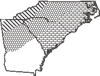
CLICK HERE to see a map, notes, and images from Weakley's Flora of the Southeastern US.
DOES THE PLANT HAVE "MILKY SAP"?
Has milky sap (latex)
LEAVES:
Simple
Alternate
FLOWER:
Summer/Fall
Blue-violet/ Bluish-white
Bilaterally symmetrical
5-lobed calyx
2-lipped 5-lobed corolla
5 stamens, completely united
Bisexual
Flowers in a terminal raceme
FRUIT:
Summer/Fall
Capsule
TO LEARN MORE about this plant, look it up in a good book!
- All About South Carolina Wildflowers (Midgley, 1999) p195
- Great Smoky Mountains Wildflowers (Campbell, Hutson, Sharp, & Hutson, 1962) p128
- Guide to the Wildflowers of SC, 1st ed. (Porcher & Rayner, 2001) p150
- Guide to the Wildflowers of SC, 2nd ed. (McMillan, Porcher, Rayner, & White; 2022) p182
- Newcomb's Wildflower Guide (Newcomb, 1977) p052
- Wildflowers of the Atlantic Southeast (Cotterman, Waitt, & Weakley, 2019) p401
- Wildflowers of the Eastern United States (Duncan & Duncan, 1999) P103
- Wild Flowers of NC, 2nd edition (Justice, Bell, & Lindsey, 2005) p245
- Field Guide to the Wildflowers of Georgia (Chafin, 2016) p146
- Wildflowers of Tennessee (Carman, 2005) p257
- Wildflowers of Tennessee, the Ohio Valley, and the Southern Appalachians (Horn, Cathcart, Hemmerly, & Duhl, 2005) p300
- Wildflowers of the Southern Mountains (Smith, 1998) p170
If a search such as "Carex leptalea var. leptalea" doesn't deliver the results you want, try "Carex leptalea".
Or, to minimize chances of a misspelling, try just "Carex le".
Less is more: If "pencil flower" doesn't deliver the results you want, try "pencil".