South Carolina's Natural Wildflower Communities —
THE COASTAL PLAIN:
The depression meadow community
Depression meadows
Depression meadows are temporally flooded herbaceous communities that have saturated soil. Since they are isolated wetlands, these meadows generally do not have a source of water other than rainwater. During times of drought, fires often occur, preventing a woody flora from becoming established. Depression meadows differ from freshwater marshes in that the latter are more or less permanently flooded. The lack of fire in marshes allows woody species to become established and sometimes to ultimately dominate the community
Classification of depression meadows is unclear, and much fieldwork needs to be done to fully understand these communities. One type of depression meadow being studied occurs in clay-based Carolina bays. These seem to share a basic floristic similarity, with numerous species in common, especially rare ones. The clay soil prevents water from percolating down into the soil, and during times of rain, the bay is flooded. Since the bays are different depths, water level varies. The deeper bays often have open water that supports species of the floating aquatic community such as fragrant water-lily and water-shield. The more shallow bays are dominated by sedges, rushes, and grasses.
Some of the wildflower species of note are
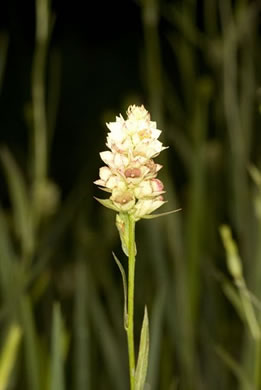
Boykin’s lobelia (Lobelia boykinii),
shrubby seedbox (Ludwigia suffruticosa),
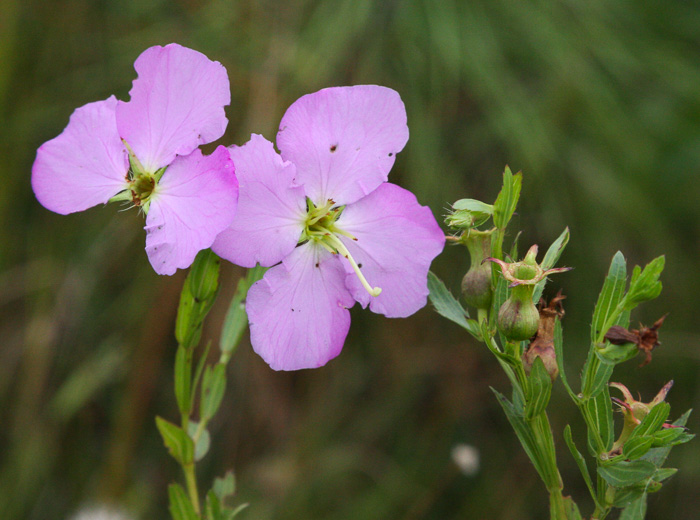
awned meadow-beauty (Rhexia aristosa),
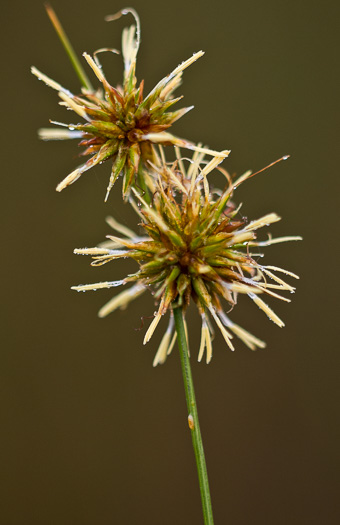
Tracy’s beaksedge (Rhynchospora tracyi),
sclerolepis (Sclerolepis uniflora),
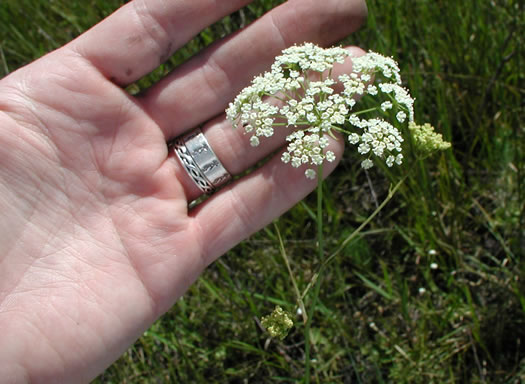
and the endangered Canby’s dropwort (Oxypolis canbyi).
There are no depression meadows in the coastal plain that have been protected by South Carolina's Heritage Trust Program. Two Carolina bays that harbor depression meadows that are available to the public are Red Bluff Creek Carolina Bay in the FMNF and Craig Pond in Barnwell County. Both are described in the “Field guide to natural plant communities” [in A Guide to the Wildflowers of South Carolina].
South Carolina's Natural Wildflower Communities is adapted from A Guide to the Wildflowers of South Carolina by Richard D. Porcher and Douglas A. Rayner. Used by permission.
To see pictures or additional information about a particular plant, click its name or its picture.