Invasive Species
The term “native” is used to describe plants that were growing here before the arrival of Europeans. Exotics are those that do not naturally occur in an area but have been introduced by people.
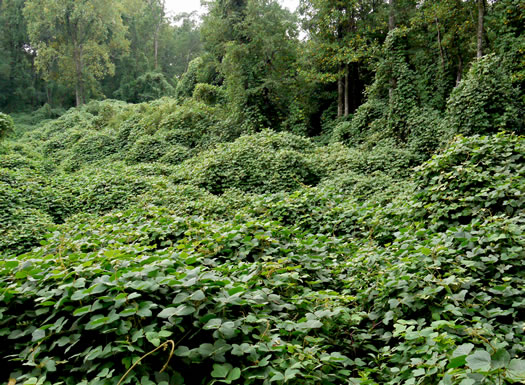
Many exotic species pose no threat, but some are invasive and grow out of control — displacing native plants which provide food and shelter for an assortment of native wildlife. Unfortunately, it is not always possible to predict if or when a species will become a pest plant (for example, Japanese honeysuckle was planted as an ornamental for 80 years before it escaped cultivation!), but a red flag should run up at any non-native with fleshy fruits dispersed by birds.
NameThatPlant.net attempts to make the viewer aware of species which have been found to cause problems in natural areas of the Southeast by labeling that plant as INVASIVE. Some of these plants are a greater threat than others (for more information, explore the links below) but we recommend that they not be planted, expecially near a natural area.
Invasive.org, Center for Invasive Species and Ecosystem Health
Invasive.org focuses on Invasive and Exotic Species of North America, that is, any species, including its seeds, eggs, spores, or other biological material capable of propagating that species, that is not native to that ecosystem; and whose introduction does or is likely to cause economic or environmental harm or harm to human health. Here you can find species profiles, images, publications, videos, how to and FAQs.
https://www.invasive.org/
EDDMapS
EDDMapS — Early Detection and Distribution Mapping System — is several things.
It is a web-based mapping system for documenting invasive species and pest distribution that is fast, easy to use, and doesn't require Geographic Information Systems experience,
and it is a website that anyone can use to see up-to-date county-level maps tracking the spread of invasives throughout the country.
https://www.eddmaps.org/
Plant Invaders of Mid-Atlantic Natural Areas
This book includes information and control guidance on 80 invasive species. A section called “Plants to Watch” includes a number of species that may not be widespread but are increasingly catching the attention of ecologists,
land managers and others as being invasive in natural habitats. Native plant alternatives have been consolidated in a separate
section.
Click here to download a PDF.
Plant Conservation Alliance: Least Wanted Alien Plant Invaders of Natural Areas
Illustrated, easy-to-read fact sheets on invasive alien plants with native ranges, plant descriptions, ecological threats, U.S. distributions and habitats, background of introductions, plant reproduction and dispersal, management approaches, alternative native plants, and other useful information.
https://www.invasive.org/alien/factmain.htm
US Fish & Wildlife Service
Weed of the Week
Access to invasives plant lists and over 100 Weed of the Week factsheets, which include plant description, habitat and distribution information, ecological impacts, and control and management information. Prepared by the USDA Forest Service (Northeastern Area).
www.invasive.org/weedcd/html/wow.htm
Invasive Plant Atlas
A collaborative project between the National Park Service, the University of Georgia Center for Invasive Species and Ecosystem Health, the Invasive Plant Atlas of New England and the Lady Bird Johnson Wildflower Center. The purpose of the Atlas is to assist users with identification, early detection, prevention, and management of invasive plants. The focus is on non-native invasive plant species impacting natural areas, excluding agricultural and other heavily developed and managed lands. Four main components are species information, images, distribution maps, and early detection reporting procedures.
https://www.invasiveplantatlas.org/
Nonnative Invasive Plants of Southern Forests — USDA Forest Service
This book provides information on accurate identification and effective control of the 33 nonnative plants and groups that are currently invading the forests of the 13 Southern States, showing both growing and dormant season traits. It lists other nonnative plants of growing concern, control strategies, and selective herbicide application procedures.
https://www.srs.fs.usda.gov/pubs/gtr/gtr_srs062/
Downloadable Invasive Plant Fact Sheets from the National Park Service
https://www.nps.gov/orgs/1103/ipp.htm
Invasive Exotic Plants of North Carolina
An 185-page manual compiled by the North Carolina Department of Transportation.
Download a PDF.
Invasive Plant Pest Species of South Carolina
A 16-page booklet compiled by the Clemson Extension Service, SC-EPPC, SC Forestry Commission, and the US Forest Service.
Download a PDF.
Cogongrass, one of the top ten noxious weeds in the world
www.cofc.edu/~everettj/cogongrass.html
Cogongrass
Website developed, maintained and hosted by the Center for Invasive Species and Ecosystem Health at the University of Georgia
https://www.cogongrass.org/
Cogongrass in South Carolina
https://www.se-eppc.org/southcarolina/scinvasives.pdf
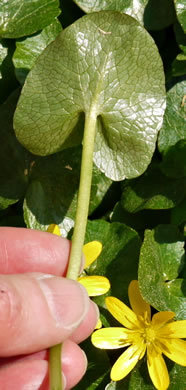
Invasive Alert: The insidiously invasive Lesser Celandine
Don't let anyone tell you that ‘Brazen Hussy’ (or any other Ficaria cultivar) is not invasive! Reprinted from the the Spring 2011 edition of New Leaf, the newsletter of the Botanical Gardens at Asheville.
Click here.
Citizen Science & the invasive Fig Buttercup
Information and a video about Fig Buttercup (Ficaria verna, formerly Ranunculus ficaria) an early-blooming perennial turned aggressively invasive.
scnps.org/education/citizen-science-invasive-fig-buttercup
Organizations
Southeast Exotic Pest Plant Council
Florida Exotic Pest Plant Council
Georgia Exotic Pest Plant Council
Georgia Invasive Species Task Force
North Carolina Invasive Plant Council
South Carolina Exotic Pest Plant Council
www.se-eppc.org/southcarolina/
Tennessee Invasive Plant Council
Type only the first 2-3 letters to choose from a dropdown list of genera (this can be especially helpful when you're not sure of the spelling).
If "wooly" doesn't deliver the results you want, try an alternate spelling such as "woolly" or just "wool".