
Hovering over an image will enlarge it and point out features (works better on desktop than on mobile).
 A camera indicates there are pictures.
 A speaker indicates that a botanical name is pronounced.
 A plus sign after a Latin name indicates that the species is further divided into varieties or subspecies.
Most habitat and range descriptions were obtained from Weakley's Flora.
Your search found 1 taxon in the family Xerophyllaceae, Beargrass family, as understood by Weakley's Flora.
)
)
)
)
)

 Common Name:
Eastern Turkeybeard, Beargrass, Mountain-asphodel
Common Name:
Eastern Turkeybeard, Beargrass, Mountain-asphodel
Weakley's Flora: (4/14/23) Xerophyllum asphodeloides FAMILY: Xerophyllaceae
SYNONYMOUS WITH PLANTS National Database: Xerophyllum asphodeloides FAMILY: Liliaceae
SYNONYMOUS WITH Vascular Flora of the Carolinas (Radford, Ahles, & Bell, 1968): Xerophyllum asphodeloides 041-15-001 FAMILY: Liliaceae
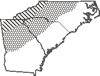
Habitat: Dry ridges and slopes in the mountains, primarily in dry, strongly acidic sites which burn periodically, such as pine/heath woodlands and forests, heath balds, and xeric oak forests, most of the populations in the Blue Ridge Escarpment, often associated with Pinus rigida or P. pungens, disjunct to similar sites on quartzite monadnocks of the upper Piedmont, in the Coastal Plain in acidic pinelands, and rarely in montane bogs
Uncommon in NC (rare in GA & SC)
Native to the Carolinas & Georgia
Your search found 1 taxon. You are on page PAGE 1 out of 1 pages.