
Hovering over an image will enlarge it and point out features (works better on desktop than on mobile).
 A camera indicates there are pictures.
 A speaker indicates that a botanical name is pronounced.
 A plus sign after a Latin name indicates that the species is further divided into varieties or subspecies.
Most habitat and range descriptions were obtained from Weakley's Flora.
Your search found 2 taxa in the family Capparaceae, Caper family, as understood by Vascular Flora of the Carolinas.

)
)
)
)
 Common Name:
Cleome, Spiderflower, Pinkqueen
Common Name:
Cleome, Spiderflower, Pinkqueen
Weakley's Flora: (2/10/25) Tarenaya houtteana FAMILY: Cleomaceae
SYNONYMOUS WITH PLANTS National Database: Cleome hassleriana FAMILY: Capparaceae
SYNONYMOUS WITH Vascular Flora of the Carolinas (Radford, Ahles, & Bell, 1968): Cleome houtteana 087-01-001 FAMILY: Capparaceae
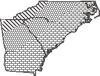
Habitat: Gardens, disturbed areas, sandbars, riverbanks, persistent and self-seeding from cultivation as an ornamental
Uncommon in SC Coastal Plain (rare elsewhere in GA-NC-SC)
Non-native: South America
Common Name: Cleome, Fringed Spiderflower
Weakley's Flora: (2/10/25) Sieruela rutidosperma FAMILY: Cleomaceae
SYNONYMOUS WITH PLANTS National Database: Cleome rutidosperma FAMILY: Capparaceae
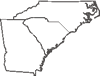
Habitat: Disturbed areas
Non-native: tropical Asia & Africa
Your search found 2 taxa. You are on page PAGE 1 out of 1 pages.