
Hovering over an image will enlarge it and point out features (works better on desktop than on mobile).
 A camera indicates there are pictures.
 A speaker indicates that a botanical name is pronounced.
 A plus sign after a Latin name indicates that the species is further divided into varieties or subspecies.
Most habitat and range descriptions were obtained from Weakley's Flora.
Your search found 3 taxa in the family Azollaceae, Mosquito Fern family, as understood by Vascular Flora of the Carolinas.
)
)

 Common Name:
Carolina Mosquito-fern, Eastern Mosquito-fern, Water Fern
Common Name:
Carolina Mosquito-fern, Eastern Mosquito-fern, Water Fern
Weakley's Flora: (4/14/23) Azolla caroliniana FAMILY: Salviniaceae
SYNONYMOUS WITH PLANTS National Database: Azolla caroliniana FAMILY: Azollaceae
SYNONYMOUS WITH Vascular Flora of the Carolinas (Radford, Ahles, & Bell, 1968): Azolla caroliniana 015-01-001 FAMILY: Azollaceae
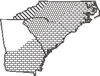
Habitat: Stagnant waters of interdune ponds, limesink ponds, old millponds, beaver ponds, floodplain sloughs, often locally abundant
Common in Coastal Plain of GA & SC, uncommon to rare elsewhere in GA-NC-SC
Native to the Carolinas & Georgia
Common Name: Large Mosquito-fern
Weakley's Flora: (4/14/23) Azolla filiculoides FAMILY: Salviniaceae
SYNONYMOUS WITH PLANTS National Database: Azolla filiculoides FAMILY: Azollaceae
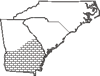
Habitat: Freshwater lakes, beaver ponds, artificial impoundments
Reported for one site in eastern Georgia
Native: western US, Mexico, Central & South America, east Asia
Common Name: Pinnate Mosquito-fern, Asian Mosquito-fern, Feathered Mosquito-fern
Weakley's Flora: (4/14/23) Azolla pinnata ssp. asiatica FAMILY: Salviniaceae
SYNONYMOUS WITH PLANTS National Database: Azolla pinnata ssp. asiatica FAMILY: Azollaceae
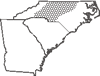
Habitat: Still waters
Waif(s)
Non-native: Asia
Your search found 3 taxa. You are on page PAGE 1 out of 1 pages.